
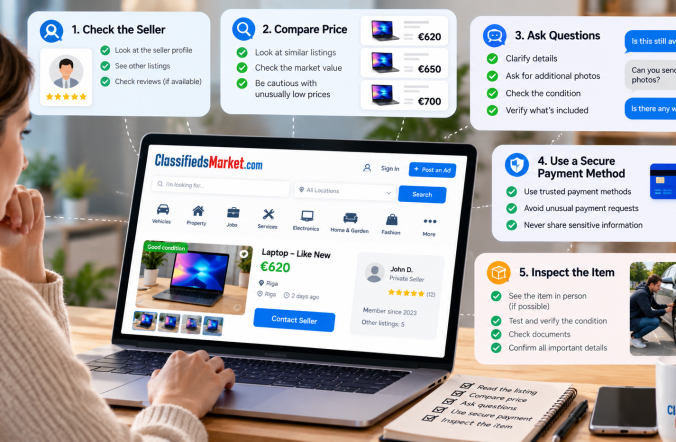
How to Buy Safely on an Online Marketplace
Online marketplaces make it easier to find products, services, vehicles, property, and other opportunities from sellers in many different locations. However, buyers should always take reasonable precautions before completing a transaction.
A good listing does not automatically mean that a seller or offer is trustworthy. Taking a few minutes to check the details, ask questions, and consider the payment and delivery arrangements can help you make safer purchasing decisions.
Check the Listing Carefully
Start by reading the entire listing rather than looking only at the title and price.
Pay attention to:
- The description of the product or service
- Photographs
- Price
- Location
- Condition
- Included accessories or equipment
- Delivery or collection information
- Seller-provided contact details
If important information is missing, ask the seller before making a decision.
Be particularly careful if the description is very short but the seller is asking for a significant payment.
Compare the Price
Before contacting a seller, look at similar listings on the marketplace and, where appropriate, other sources.
A price that is significantly different from comparable offers does not necessarily mean that something is wrong. There may be a legitimate reason, such as the condition, age, location, or features of the item.
However, an unusually low price can be a reason to investigate further.
Ask yourself:
- Is the price realistic for the item?
- Is the condition clearly explained?
- Are there photographs showing the actual item?
- Is there a reasonable explanation for the price?
Avoid making a payment simply because you are worried that someone else will buy the item first.
Learn About the Seller
Look at the information available about the seller.
Depending on the marketplace, you may be able to see:
- Seller name or business name
- Location
- Seller profile
- Other listings
- Account information
- Reviews or ratings, where available
A seller having a profile or previous listings does not guarantee a transaction will be safe, but this information can help you understand who you are communicating with.
If the seller is a business, you may also want to independently check the business information before making a significant purchase.
Ask Questions Before Buying
Do not hesitate to ask questions when something is unclear.
For example, you could ask:
- Is the item still available?
- What is the condition of the item?
- Are there any defects or problems?
- How long have you owned it?
- Where is it located?
- Can I see additional photographs?
- Is collection available?
- What payment methods are accepted?
A genuine seller should generally be able to provide reasonable information about the item or service.
Be Careful With Payment Requests
Payment arrangements deserve particular attention.
Be cautious if someone asks you to:
- Send money before providing sufficient information
- Use an unusual or difficult-to-reverse payment method
- Pay through an unrelated website
- Send payment to a different person without a clear explanation
- Make an immediate payment under pressure
For expensive purchases, consider whether the payment method provides appropriate protection for the type of transaction.
Never share passwords, authentication codes, or other sensitive account information with a seller.
Be Cautious About Moving the Conversation
Sometimes a buyer or seller may want to continue communication outside the marketplace.
There can be legitimate reasons for this, but moving a conversation elsewhere can also make it more difficult to use marketplace safety and reporting tools.
If someone immediately asks you to continue the conversation through another service and then sends unusual payment instructions or links, take extra care.
Before clicking a payment link or entering personal information, make sure you know where the link leads.
Watch for Pressure and Urgency
Pressure is an important warning sign.
Be cautious if someone tells you:
- You must pay immediately
- Other buyers are waiting
- The offer will disappear within minutes
- You cannot inspect the item
- You must use a specific payment method
- You should not ask additional questions
A legitimate purchase should not normally require you to ignore reasonable safety checks simply because someone is creating a sense of urgency.
Take your time and make the decision based on the information available.
Inspect Important Items Before Buying
For higher-value purchases, an inspection can be especially useful.
Depending on what you are buying, you may want to:
- See the item in person
- Test electronics
- Inspect a vehicle
- View a property
- Check documents
- Confirm the condition
- Verify important specifications
If an in-person inspection is not practical, ask for additional photographs, videos, documents, or other information that can help you evaluate the offer.
Never Share Unnecessary Personal Information
A seller generally does not need access to sensitive information such as your account passwords or security codes.
Be careful when someone asks for:
- Passwords
- Verification codes
- Banking login information
- Copies of sensitive documents
- Unnecessary financial information
Only provide information that is genuinely required for the transaction.
Trust Your Judgment
No single warning sign proves that an offer is fraudulent. However, several unusual circumstances occurring together should make you stop and investigate further.
For example, be particularly cautious when a listing combines:
- An unusually low price
- Pressure to pay quickly
- Limited information
- Refusal to answer questions
- Unusual payment instructions
- Requests for sensitive information
If the situation does not feel right, you do not have to complete the transaction.
What to Do If Something Goes Wrong
If you believe that a listing or transaction may be fraudulent, stop communicating or sending money until you understand what is happening.
Use the marketplace’s reporting tools when available and keep relevant information such as:
- Listing details
- Messages
- Payment records
- Contact information
- Photographs
- Other transaction information
If money has already been sent or sensitive information has been disclosed, consider contacting the relevant financial institution or appropriate authorities as soon as possible.
A Simple Safe Buying Checklist
Before completing an online marketplace purchase, ask yourself:
✓ Have I read the listing carefully?
✓ Have I compared the price with similar offers?
✓ Do I understand the condition of the item?
✓ Have I checked the available seller information?
✓ Have I asked questions about anything that is unclear?
✓ Am I comfortable with the payment method?
✓ Have I avoided sharing unnecessary personal information?
✓ Have I avoided making a rushed decision?
✓ For an expensive purchase, have I taken appropriate steps to verify the item?
If the answers are yes, you have taken several sensible steps to reduce unnecessary risk.
Conclusion
Online marketplaces can make buying easier by bringing many products, services, and sellers together in one place. At the same time, buyers should take responsibility for checking listings, asking questions, evaluating sellers, and using appropriate payment and communication methods.
The safest approach is simple: take your time, verify important information, and do not allow pressure to replace careful decision-making.